
Developments in direct laser engraving have opened new possibilities for the flexographic printing industry. Direct engraving has the potential to improve quality while improving cost efficiency. Start-up waste, registration, make-ready time and print speed all favor the choice of direct engraved flexo sleeves.
Direct engraved sleeve technology offers a number of distinct advantages:
- Elastomer covered sleeves can be changed quickly.
- Various working widths can be realized using a single mandrel size.
- Fewer additional cylinders are required for a given press, reducing investment costs.
- Low sleeve weight facilitates ease of handling.
- Only sleeves need to be transported; mandrels and cylinders remain in place.
- Storage of rubber covered cylinders is no longer necessary.
- Sleeves can be stored vertically requiring less warehouse floor space.
Why BöttcherFlex Sleeves?
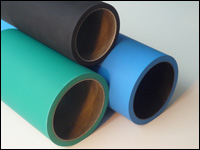 Böttcher’s specialized elastomers have been developed to meet all of your needs, whether you use solvent or water-based inks. We offer fiberglass covered sleeves and flat sheets with mylar backing of excellent quality for direct engraving. During engraving, the material becomes “ash” leaving no smears and an impeccable surface with crisp edges and precise, sharp screen dots. Our sleeves for tint and solid background colors offer uniquely full ink coverage, which has been confirmed again and again by our customers.
Our state-of-the-art rubber covered cylinders and sleeves for gravure impression, available as both conical and tapered sleeves, also boast a superior surface. Böttcher prides itself on its precise sleeve geometry with optimum concentricity and cylindrical values which gives us the ability to meet all of your flexography and rotogravure printing needs.
Introductory Information
Standard Böttcher base sleeves are made of a thin tube of GFRP plastic (glass-fiber-reinforced-plastic). The finished sleeve consists of the plastic sleeve base and an elastomer covering. The sleeve base is fitted over a steel air mandrel with the aid of compressed air. It glides over an air cushion and can be fitted easily by hand. When air pressure is released, the sleeve base is firmly fixed to the mandrel. When compressed air is then applied again, the covered sleeve can be removed from the air mandrel. Due to their thin walls, sleeve bases can ordinarily be processed only on suitable mandrels.
Depending on the specific application, sleeve bases may be conical or cylindrical. Conical sleeve bases are normally used in gravure printing while cylindrical sleeve bases are used primarily in flexo printing. The nominal diameter, or basic core diameter (BCD) corresponds approximately to the outside diameter of a sleeve base, thus it is comparable to the core diameter of a conventional steel roller.
In order to expand under air pressure, sleeve bases and sleeves must exhibit a certain degree of flexibility. This flexibility is lost if sleeve base walls are too thick or the elastomer covering is too hard.
Sleeve bases are labeled during the production process. The label is embedded in the resin matrix and thus cannot be removed. It provides information such as an identification number in which a sleeve can be monitored as well as the BCD, sleeve length, if the sleeve is conical or cylindrical and the date the sleeve was manufactured.
The physical mechanical properties of sleeves – dynamic characteristics, abrasion resistance, electrical properties and chemical properties – must all be considered in the selection of a suitable compound covering. The behavior of specific media in contact with Böttcher compounds can be analyzed through testing at our laboratory to assist in selecting a sleeve system and material that will best meet the requirements necessary for the needs of the customer.
Tint Sleeves
One of the most basic types of sleeves is the Tint Sleeve, also known as a flood coat. This is a rubber product generally used to meter ink. They are used to apply inks, adhesives, primers and clear overcoats as well as for creating continuous stripes on a web. Böttcher has a single material that can be used on a tint sleeve with any type of ink.
Laser Engraved Sleeves
Laser Engraved Sleeves are sleeves that are manufactured and then images are engraved into the sleeves to be printed. The rubber is vulcanized and thus directly adhered to the sleeve. This prevents any cupping or curling. The sleeve is reusable and it can be recovered. The image is applied using digital direct laser ablation.
Sleeves, Repeats and Bridges
A significant difference between traditional presses and new flexo presses is the use of a fixed mandrel at each print station. Sleeves of any thickness can be mounted to the mandrel with air pressure being used to expand the sleeve and then by removing the air pressure causing the sleeve to tightly grip to the mandrel. This is called an interference fit.
When using a sleeve press, printers must decide how they will reach the required repeats. The press comes with at least one fixed mandrel per print station. They need to fill the gap between the fixed mandrel diameter and the required print diameter. The choices are basically to use thick sleeves or use a Bridge Sleeve/Mandrel with a thin sleeve. A Bridge Sleeve/Mandrel is similar to a thick sleeve in that it has a certain thickness to increase the repeat size. The big difference is that the bridge mandrel has the ability for air to pass through its wall thickness, thus allowing a sleeve to be mounted over the top of the bridge. In some repeats, a bridge mandrel is no different than a metal cylinder that has been drilled for air to accept sleeves. Both allow the printer to increase their repeats with the addition of a sleeve over the top.
Application Tips:
Mounting and Dismounting
Use clean, dry compressed air to mount and remove sleeves. Avoid air contaminated with oil or water. Suggested air pressure to mount and dismount sleeves is 75-110 psi. Adjust pressure based on sleeve size. To remove a stuck sleeve, gradually increase air pressure until sleeve is free.
Cleaning
Typically, sleeves used with water-based inks can be washed with plain water and a damp cloth. For stubborn soiled spots, use Böttcherin Aquasol (add a link to Böttcherin Aquasol under Pressroom Chemistry, Roller Care/Printing Aides).
Storage
To minimize storage footprint, store sleeves vertically. Sleeves may also be stored horizontally as long as they are supported internally. Do not store sleeves with their outer surface in contact with any hard surface, as this may produce a flat spot on the print surface. To protect sleeves from dirt, mechanical damage and harmful UV, re-wrap sleeves with the special Böttcher paper supplied with each sleeve.
If you would like additional information about Böttcher’s Flexo Products, please contact us at 800-637-8120 or support@boettcher-systems.com. Further information regarding Böttcher’s flexo technologies can be found on our worldwide website at www.boettcher.de.